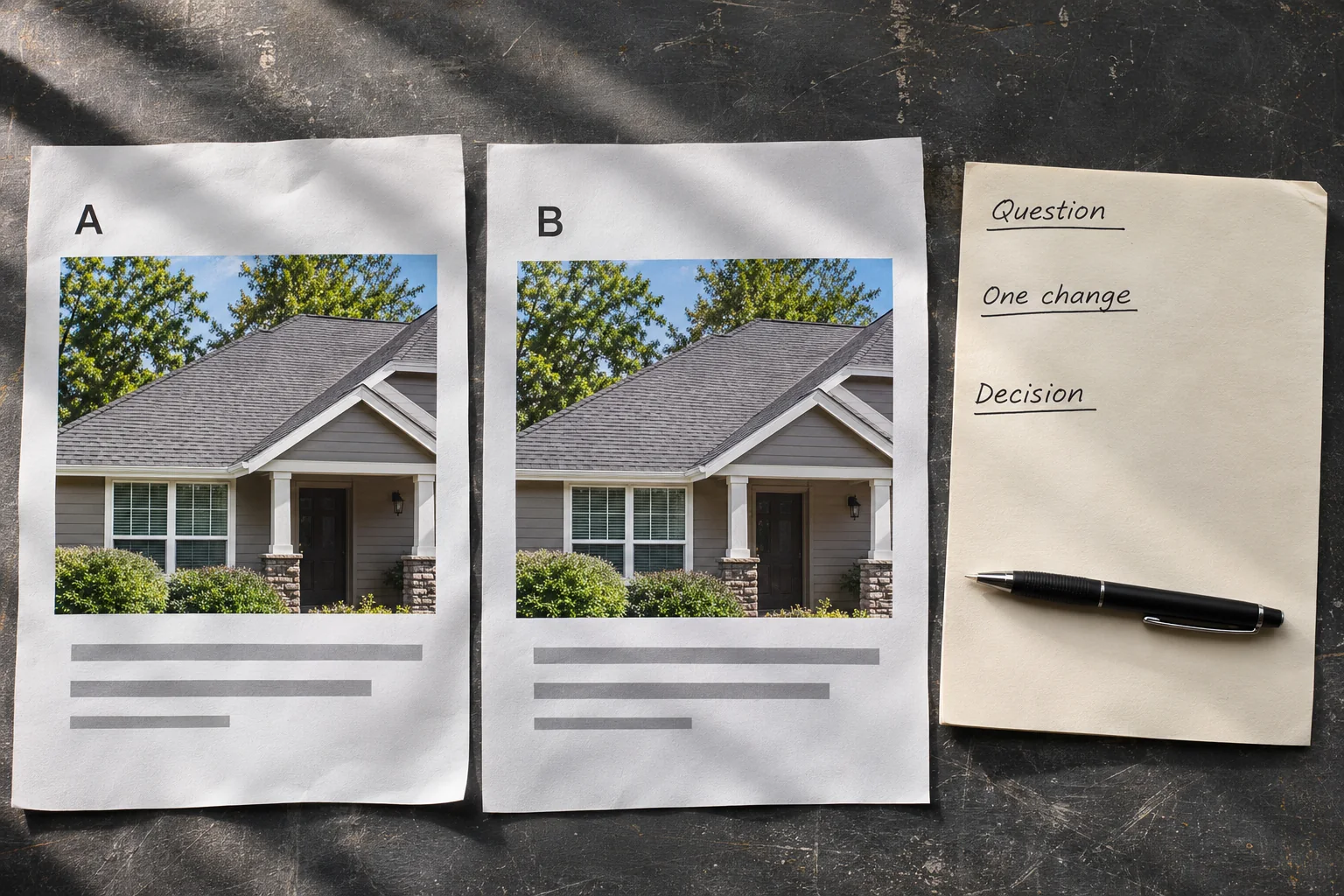
At TCM, I want a roofing ad test to earn its next step. Start with a business question, make a controlled comparison, and inspect what happened before expanding. Our roofing focus keeps the decision tied to work your crew can take. Client-owned ad accounts keep the campaign history available for review.
The short answer
Choose one change, agree on the outcome and budget, and use a supported test for the actual campaign. Check that the records can measure what you want to compare. Read the results after allowing for follow-up and reporting delays. Keep an inconclusive result as inconclusive.
Start with one change and a reason to test it
Google recommends a clear hypothesis tied to a business goal, one variable at a time, and success measures chosen before the test begins.[1]
Proposed roofing example: a replacement-only company wants its Search ad to make the service clearer. Test a revised headline theme while keeping the approved offer, service area and destination consistent. The question is whether the clearer message improves the measured response without attracting work the business cannot serve.
A different week with more inquiries is useful operating information. I would also ask what changed in weather, demand, spending and office coverage before crediting the headline. Use our Google Ads budget guide to set an affordable allocation for the work.
Use the test that fits the campaign
Google’s ad variations tool supports responsive Search ads. It lets you select the scope, change the ad text, and set details such as the end date and percentage of traffic receiving the variation.[2]
That is a useful route to review for the headline example. Bidding, landing-page and other campaign changes may call for another experiment type. Google lists different tools for different tests; have your provider verify the current route and eligibility in your account.[6]
Agree on the allocation and what remains unchanged before launch. Do not assume copying a campaign or leaving two ads active creates the comparison you intended. If the available traffic is too thin to answer the question, choose a smaller operational improvement or defer the experiment.
Write this brief before approving the test
This is my proposed worksheet for a roofing owner and campaign manager. Complete it together, then keep it with the campaign record.
| Decision | What to write down |
|---|---|
| Question | The service and customer decision you want to improve. Name the current problem. |
| One change | The exact original and proposed version, with the offer and other conditions held steady. |
| Supported route | The eligible campaign, test tool, scope and traffic allocation your provider has checked. |
| Outcome and evidence | The main measure, its source, and how each version connects to it. Record any gap. |
| Costs and timing | The approved allocation, start and review dates, reporting delay and office follow-up owner. |
| Protection and approval | Who checks delivery, who can stop a broken test, and who approves applying the result. |
| Decision | What would justify adopting, revising or holding the change, including insufficient evidence. |
A broken form, wrong phone destination or inaccurate offer needs repair. Stop and document the issue under the agreed process rather than treating those records as a fair test.
Check what you can actually measure
A usable inquiry or booked inspection can be a sensible business goal. It is only a valid comparison between versions when your setup can reliably connect each outcome to the version that generated it.
An ad variation may run inside one Search campaign. A CRM campaign name alone therefore does not establish which version produced the inquiry. Ask the provider to show the verified connection. If it is missing, limit the test conclusion to what the available records support; do not invent a version-level booking result.
Review the first request and response path in an approved test environment, with test records excluded from genuine results and advertising exports. Our estimate-form guide covers the request, and the lead-to-job guide follows the later outcomes. Keep office feedback beside the figures.
Read the result without forcing a winner
Google’s ad-variation reporting shows the observed change, a confidence interval and significance information. Review the actual counts and uncertainty alongside the percentage difference.[3]
Conversion delays also matter. Google explains that a recent period can look worse while spend is already reported and some conversions have yet to arrive.[4] Agree on a review window that fits the test and your follow-up cycle. A deadline alone does not make the evidence sufficient.
The current experiment reporting help describes AI-generated summaries. I’d use them to surface questions, then check the underlying figures. The same guidance recognizes that some results have no clear winner and that certain experiment types can automatically apply favorable results.[5] Review application settings before launch so the person responsible for the campaign controls the next step.
Adopt a supported improvement when the evidence and business fit justify it. Revise a test with a documented delivery or measurement problem. Hold when there is too little evidence or the change attracts unsuitable work. A lower cost per click alone would not persuade me to expand.
Bring TCM the decision you want to improve
TCM’s paid-media plans include campaign strategy, conversion tracking, optimization and reporting. Testing work and its scope are agreed before launch. You own the ad accounts and pay the platforms directly.
Request a free marketing audit. Bring the current campaign, one proposed change and the office feedback behind it. We can identify a useful question, check what can be measured, and agree on a focused next step.
Sources and research notes.
The sources below support the platform facts in this guide. Roofing examples and suggested decisions are my practical applications. Any illustrative numbers are labeled in the article.
- Google Ads: testing with a clear hypothesis and one variable — reviewed 2026-11-07
- Google Ads: responsive Search ad variations — reviewed 2026-11-07
- Google Ads: reading ad-variation results — reviewed 2026-11-07
- Google Ads: conversion delays and recent performance — reviewed 2026-11-07
- Google Ads: experiment monitoring, AI summaries and application settings — reviewed 2026-11-07
- Google Ads: choosing an experiment type — reviewed 2026-11-07
Gordon Brown
The Contractors Marketing